
The Yanomami: The Answer to Humanity's Dilemma
- Britney Cordero
- Apr 1, 2025
- 6 min read

Updated: Apr 3, 2025
How far can one be pulled from the authenticity of reality until they are completely lost? We, as individuals are living variables to this hypothesis.
Humans only have one mind, and because of that, man is limited to perspective and may never truly experience reality. However, man does not ground himself through indulgence.
Indulgent describes our modern, industrialized society. Man has evolved, man was put in a world that required hard work and built a new one to accommodate for comfort and sensual pleasures.
Man has lost grasp of what is real. With how developed our societies have become, it may be impossible to think of a life without technology, transportation, facilities, hospitals, and all of the other endless comforts we have placed in our life that we have labeled as "necessities".
But maybe... a life like this would be better. Maybe, if society was focused on living in harmony with nature rather than against it, we would find more peace.
We can observe this kind of lifestyle by viewing the Yanomami.

Introducing the Yanomami
The Yanomami are an indigenous group in the Amazon, spreading from Venezuela to Brazil.
They are a horticultural society, meaning they practice agriculture by first cutting and then burning the trees from the desired area of plantation.
This is different from agricultural societies like the Inca or Aztecs because the land cleared for plantation is not fertilized in any way.
This means that the Yanomami are more sedentary than hunter-gathers but more nomadic than agriculturalists because the soil is only capable of producing healthy crops for so long.
The Yanomami are very aware and knowledgeable of ecology and the environment that surrounds them.
In fact, they prefer to work with nature instead of against it, making their own presence as part of the ecosystem.
Compared to groups like the Hadza, the Yanomami are larger in number because their gardens can provide for more people along with their increased social interactions.
Just like any society, there is a division of labor within the Yanomami society where women are largely in charge of producing food and men are most widely involved in economic and political affairs.
Their religion is based on Animism, which is the attachment of spirits to real world things such as nature, inanimate objects, or natural phenomenon, and the spirituality amongst the Yanomami is quite intense.
The spirituality amongst the group can be demonstrated by the practices of the shaman. They are not only in charge of doing ritualistic practices for healing of sickness, they have direct contact with the spirits.
Ebene
It is common for the Yanomami to consume a hallucinogen known as Ebene. This substance allows for the Yanomami to enter a mental war between themselves and the intensity of the spirits.
They use this moment as a test of mental strength, but also to enter another spiritual realm that allows them to contact the spirits. They will sometimes use this opportunity to turn the spirits, known as the hekura spirits, against other Yanomami villages.
Cultural Anthropologist, Napoleon A. Chagnon, describes the preparation and use of Ebene as the following:
"The men usually make a batch of Ebene every day; sometimes several different groups of men in a village each make their own batch...
The men paint themselves elaborately with red pigment, put on their fine feathers, and then gather around the front of the house of the host.
A long hollow tube, mokohiro, is used to blow the powder into the nostrils. A small amount, about a teaspoonful, is pushed by finger into one end of the tube to load it.

The other end, to which a large, hollowed plan seed has been fashioned as a nostril piece, is put into a companion's nose.
The green powder is then blown into the nasal cavity with a powerful, long burst of breath that starts slowly and terminates with a vigorous blast." (Chagnon, 54-55)
Ebene is an essential part of the Yanomamö's connection to the spiritual realm that allows that to live with nature.
Camping
Occasionally, the Yanomami will go on waiyumö (camping) which tends to last for an extended period of time. These camping trips are planned strategically, with the time of the camping aligning with the ripening of the fruits in the area.
Similar to many other societies, camping is a leisure time, it Is meant for fun, but also to break away from the normal diet.
During waiyumö, the Yanomami will take time away from their gardens and rely on the surrounding fruits and vegetables that nature has provided to them.
Although the Yanomami are quite reliant on their gardens in day to day life, they are also hunters. In fact, "The Yanomamö, in short, exploit a wide variety of animal protein resources and enjoy a high standard of of living by world health standards." (Chagnon, 61).

Naturalness is not only the expectation for the Yanomami diet, it is also very important to their shelter.
Every material used to construct houses are derived from the jungle. This includes vines, poles, an leaves. Within Chagnon's research, he found that the Yanomami have a clear distinction from that which is natural and that which is man-made.
The terms, yahi tä rimö refer to that of the village and/or culture whereas the term urihi tä rimö refers to that of the forest/nature (Chagnon, 56).
A Shabano is a house of permanent residence for the Yanomamö and its surrounding area. It is likely one of the most intricate and labor-intensive structures found in it's culture and demonstrates the unity between life and nature.
Teachings of the Yanomami
Groups like the Yanomami demonstrate that sustainable living is not only possible, it is essential for humans to live in harmony with nature.
The intricacy of a natural lifestyle is to be admired. It shows that living for comfort is gradually pulling humanity away from the authenticity that is earth itself.
The Yanomami way of living challenges the assumption that "industrialized" is equivalent to an improved quality of life.
Because although the industrialized way of living is comfortable for many people, it causes much suffering for the less fortunate and gradually rids humanity of its most precious natural resources while pulling man away from all that is real, all that is genuine, and all that is native.
Seeing humans who are isolated from industrialized societies in general encourages a better understanding of human nature, essentials, and pleasures.
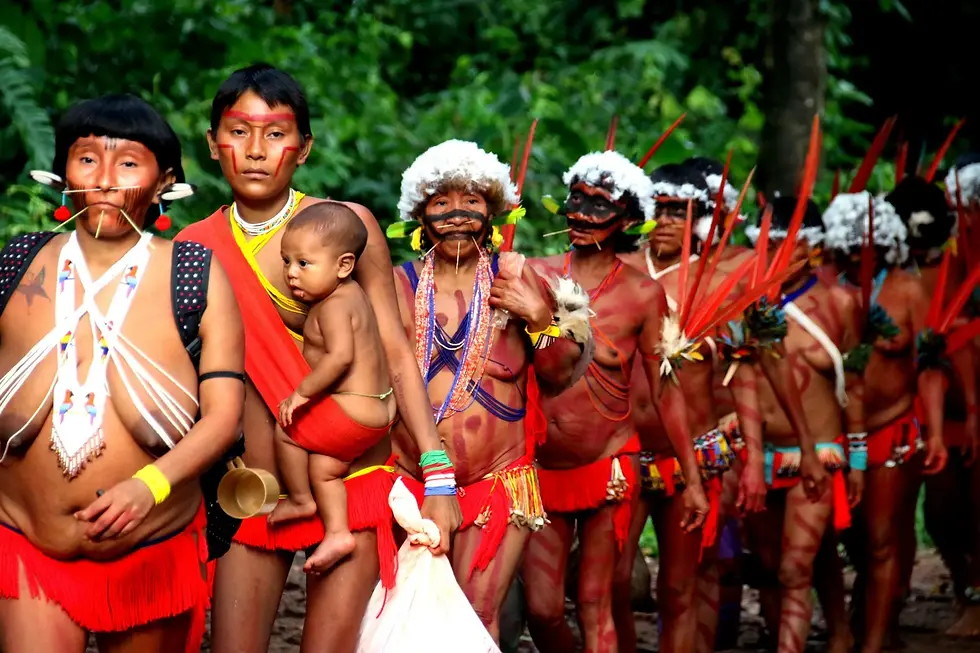
Although there are many differences within Yanomami culture from industrialized societies, there are also many similarities.
Trade, fashion, communal gatherings, celebration, and more are all human universals that show that humans may not be as different as assumed.
In fact, our commonalities prove that humans are meant to live in humble harmony with the natural world and with each other.
By observing the Yanomami, it becomes evident that living in congruency with the natural world encourages a sincere understanding of life, creating a sense of authenticity and purpose that resonates greatly with the heart of existence.
The Yanomami Today
The Yanomami are currently undergoing a humanitarian crisis due to illegal gold mining occurring in the Amazon... and this is nothing new.
It was in the 1980's that the Yanomami first faced a major killing due to gold miners.
According to SurvivalInternational.org, an organization dedicated to protecting and advocating for indigenous rights, "The miners shot them, destroyed many villages, and exposed them to diseases to which they had no immunity. Twenty percent of the Yanomami died in just seven years".

This is not a situation that is to be regarded as "history", as many Yanomami people are still suffering and continued to be poisoned, killed, and exposed to several diseases.
It is important to note that as of date, indigenous people's in Brazil do not have legal rights over their land. This allows for genocides such as that currently happening in Yanomami territory to continue.
For more information on the topic, please visit SurvivalInternational.org and get involved.
Ways YOU Can Help:
1.) Donate to the Yanomami Foundation or share with those who can donate
2.) Spread awareness on social media!
3.) Contact the Brazilian Government and demand the stop of illegal mining in indigenous territory
4.) Educate yourself on the topic (good places to start: SurvivalInternational.org, RainforestRescue, RainforestFoundation, PAHO)
Works Cited:
Chagnon, Napoleon A. Yanomamo: The Fierce People. 1968, ci.nii.ac.jp/ncid/BA07931506.
“The Yanomami.” Survival International, www.survivalinternational.org/tribes/yanomami.
@HeritageHubbcc does not claim possession of any photos or sources used within this post.


Comments